In the world of fine jewellery, a hallmark is more than just a series of tiny indentations. It is a symbol of integrity, a legal requirement, and a mark of heritage. For those manufacturing in the UK’s historic Jewellery Quarter, the question of "what is the hallmark for Birmingham?" is one we answer every day at Weston Beamor.
At Weston Beamor, we believe that hallmarking shouldn’t be a hurdle in your production timeline. That is why we have integrated a Birmingham Assay Office sub-office directly into our facility. By combining our end-to-end manufacturing with on-site Birmingham hallmarking, we offer a seamless path from 3D design to a legally compliant, retail-ready masterpiece. Here is everything you need to know about the Birmingham hallmark and why it remains the gold standard for quality.
What Is the Hallmark for Birmingham?
The hallmark for Birmingham is the Anchor.
Since 1773, the Birmingham Assay Office has used the anchor symbol to certify the purity of precious metals. Interestingly, the choice of an anchor for a landlocked city like Birmingham was supposedly decided over a coin toss at the Crown and Anchor Tavern in London, where the founders of the Birmingham and Sheffield assay offices met to decide their respective symbols.
Today, the anchor is recognised globally as a sign of rigorous testing and British craftsmanship.
The Anatomy of a Birmingham Hallmark
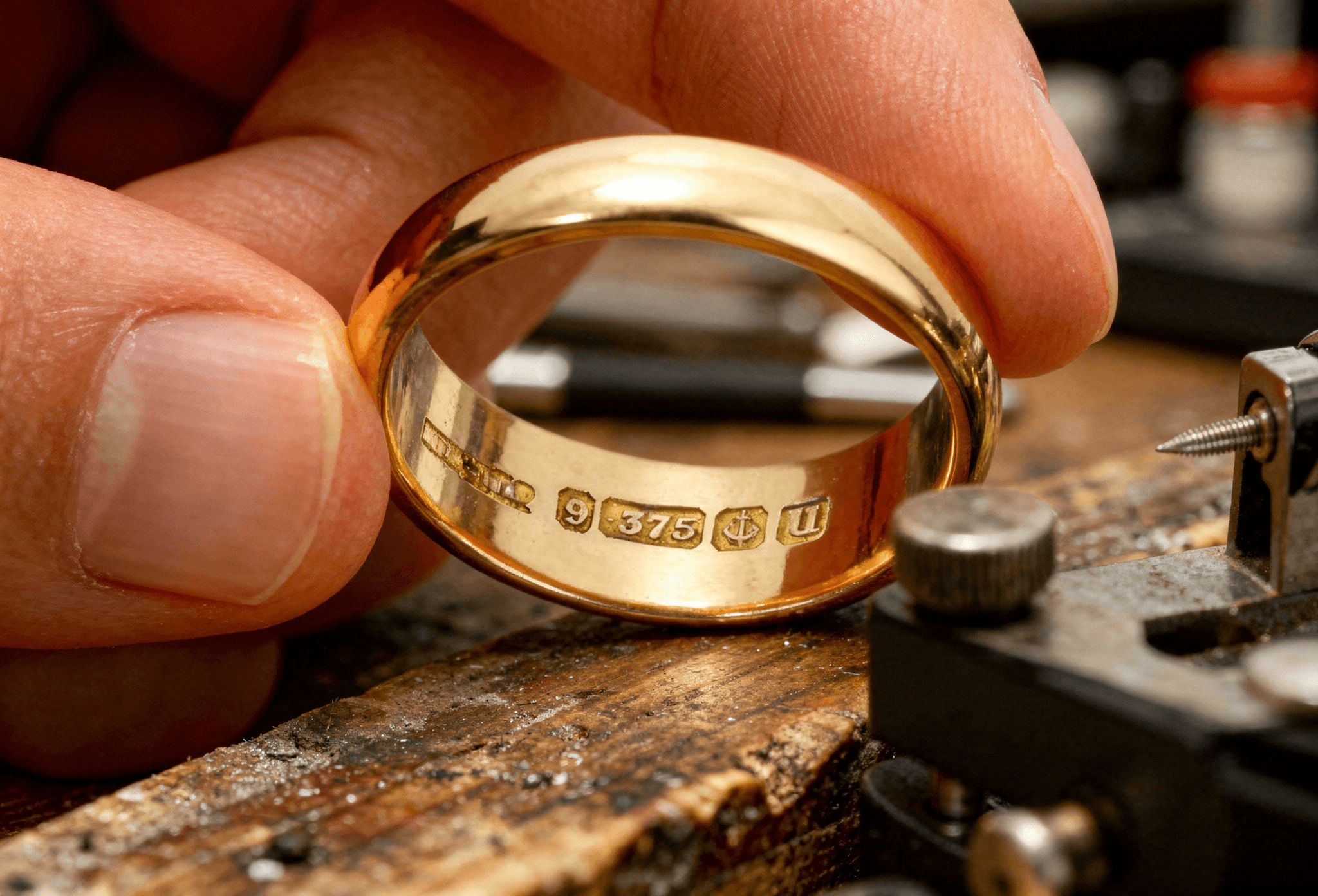
A modern hallmark isn't just one stamp; it is a compulsory set of three marks that work together to provide full traceability. When you see a Birmingham hallmark, it will typically consist of:
1. The Sponsor’s Mark
This is the unique mark of the company or person who sent the item for hallmarking. It usually consists of initials inside a shield or border. At Weston Beamor, we can apply your own registered sponsor mark, or you can use ours to simplify the process.
2. The Standard of Fineness
This tells the consumer the precious metal content. It is represented by a numerical value in a specific shape:
Gold (Measured in Carats)
9ct Gold: 375
14ct Gold: 585 (A popular standard in the US and Europe)
18ct Gold: 750
22ct Gold: 916
24ct Gold: 999 (Pure gold)
Silver
800 Silver: 800 (Common in vintage European silverware)
Sterling Silver: 925 (The most common standard for jewellery)
Britannia Silver: 958 (A higher purity often used in decorative pieces)
Platinum
Platinum: 950 (The luxury standard)
Fine Platinum: 999
Palladium
Palladium 500: 500 (A more budget-friendly alloy)
Palladium 950: 950 (The standard for high-quality bands)
3. The Assay Office Mark
This is where the Birmingham hallmark comes in. The anchor signifies that the metal was tested (assayed) by the experts at the Birmingham Assay Office.
Optional Traditional Marks
You may also see a Date Letter (identifying the year of hallmarking) or a Pictorial Mark (like the Lion Passant for Sterling Silver). While these are no longer legally compulsory, many designers include them to add a sense of heritage and completeness to their pieces.
The Legal Requirements: When Do You Need a Birmingham Hallmark?
It is a common misconception that all jewellery must be hallmarked. In reality, the Hallmarking Act 1973 specifies weight thresholds. If an item is under these weights, it is exempt. However, any item sold as a precious metal above these weights must be hallmarked by law:
- Silver items must be hallmarked if they weigh more than 7.78g. For example, a delicate silver ring weighing 2g does not legally require a hallmark, whereas a solid silver bangle weighing 20g cannot be legally sold as "Silver" without the Birmingham hallmark anchor.
- Gold items require hallmarking if they exceed a weight of 1.0g. This includes almost all rings and most pendants.
- Palladium items follow the same rule as gold, requiring a hallmark for anything over 1.0g.
- Platinum items have the strictest requirement; any piece weighing over 0.5g must be officially hallmarked to be legally sold as platinum.
Without these marks, items cannot legally be described as gold, silver, platinum, or palladium. By ensuring your Birmingham hallmarking is handled correctly, you protect your brand reputation and provide your customers with absolute peace of mind.

Stamped vs. Laser Hallmarking
As technology has evolved, so has the way we apply marks. There are now two primary methods for Birmingham hallmarking:
Traditional Punch/Stamp: This involves a physical metal punch being struck into the metal. It creates a deep, classic look that is ideal for heavier castings and traditional designs.
Laser Hallmarking: This uses a high-precision laser to etch the mark onto the surface. This is the preferred method for hollow items, highly polished finished pieces, or very delicate settings where a physical strike might cause deformation.
How Birmingham Hallmarking Supports Sustainability
In the modern industry, hallmarking is also becoming an unlikely tool for sustainability. When manufacturing is handled locally - for example, by using an on-site assay sub-office like Weston Beamor’s - the ‘carbon miles’ of a piece of jewellery are drastically reduced.
Instead of a piece of jewellery being cast in one location, shipped to an Assay Office in another, and then returned for finishing, a streamlined approach allows the entire life cycle of the product to happen under one roof. This reduces emissions from transport and lessens the risk of loss or damage during transit.
Streamlining Your Production with Weston Beamor
While the legalities of Birmingham hallmarking can seem daunting, they don’t have to slow down your production. At Weston Beamor, we provide a fully integrated, end-to-end manufacturing service that removes the administrative burden from your shoulders.
Why Work With Us?
By using our in-house Birmingham Assay Office sub-office, you benefit from:
24-Hour Turnaround: Most pieces are hallmarked within 24 hours of casting, often on the same day.
Cost Efficiency: We offer preferential rates and, crucially, no minimum parcel charges, meaning you only pay for what you hallmark.
Expert Management: We handle all submissions, documentation, and compliance on your behalf.
Full Manufacturing Support: From initial CAD design and 3D printing to casting, finishing, and hallmarking, we provide a complete service for designers, retailers, and brands.
Whether you are looking to hallmark a one-off bespoke commission or a full commercial collection, our team ensures your work meets the highest UK standards with speed and precision.
Partner with the Birmingham Hallmarking Experts
At Weston Beamor, we simplify the complex. By combining centuries-old tradition with modern on-site technology, we provide an integrated Birmingham hallmarking service that you can trust, all from the heart of the Jewellery Quarter.
Ready to streamline your production? Whether you are a solo designer or a global brand, our team is here to help you navigate the legal requirements of the UK jewellery market while delivering world-class manufacturing quality.
Contact us today to discuss your next project.

Weston Beamor has been casting precious metals since 1947. Working with a broad spectrum of customers for nearly 80 years has made Weston Beamor one of the most respected and trusted names in the jewellery industry. Company Number 00465213