
Customers are asking about sourcing, ethics, and traceability more than ever before. The UK jewellery trade has more to say on all of this than it often realises. The problem is confidence, not credentials. Here is what the research tells us about where the gap lies, and what it is worth to close it.
There is a telling exchange captured in the Luxury in Flux research. A respondent, describing a conversation they regularly have on the shop floor, put it plainly:
“Customers ask about Fairtrade but don’t understand traceability.”
Another respondent, reflecting on how they handle sustainability conversations, said:
“If the customer doesn’t ask, we don’t always go there, but maybe we should.”
Both of those observations point to the same underlying issue. The UK jewellery trade has real credentials on responsible sourcing. What it often lacks is the confidence and the habit of leading with them.
54.5% of retailers and designer/makers in our survey report receiving sourcing inquiries from customers. That number has been rising year on year. Yet only 34.7% feel very confident having those conversations. The materials are frequently already in place. The story around them is what is missing.
Why Customers are Asking
The shift in customer behaviour around sustainability is not driven by a single trend. It is a convergence of several things happening at once.
Vintage and second-hand jewellery is booming, with Retail Jeweller noting that 37% of people would gift second-hand jewellery to a loved one. Mintel found that 55% of UK jewellery shoppers deemed sustainable, ethical jewellery a priority. Hearst discovered that 36% of consumers would stop purchasing from a business they found to be unsustainable in their practices.
At the same time, the broader consumer conversation about where things come from has become more sophisticated. Customers are not just asking whether a piece is sustainable in a vague sense. They are asking specific questions about recycled gold, about mining origins, about certifications. They have done their research, and they want transparent answers.
For many customers, sustainability and personalisation are not separate concerns. They are part of the same question: does this piece reflect my values?
What the Trade is Already Doing
The honest picture from the research is that the UK jewellery trade is further along on responsible sourcing than its confidence in the conversation might suggest.
65.9% of those surveyed use recycled gold. 21.6% use Single Mine Origin (SMO) gold. 46.7% changed their material choices in the last twelve months for reasons of price, ethics, or both. These are not token gestures. They represent real sourcing decisions that give retailers and designers something substantive to talk about.
The RJC certification held by businesses like Weston Beamor provides independent assurance of ethical practices across the supply chain. SMO partnerships offer traceability back to a single verified mine, which is exactly what customers asking about origins want to hear. Recycled gold carries a clear, simple story about reducing mining impact that translates well at the point of sale.
The gap is not in the materials. It is in the telling.

What the Confidence Gap is Costing
80% of global consumers say they would pay more for sustainably sourced goods, according to PwC. That figure has held consistently across multiple years of research and multiple markets. It is not a statement of aspiration. It is a demonstrated willingness to spend more when the sourcing story is clear and credible. These are not fringe preferences pulling the market in one direction. They are mainstream expectations reshaping what the baseline looks like.
When a customer asks about recycled gold and the answer is uncertain or vague, they do not just walk away without buying. They walk away with a reduced sense of confidence in the brand. When they ask the same question of a jeweller who answers clearly and confidently, the effect is the opposite. The purchase feels better. The relationship starts stronger.
Every sourcing inquiry is a commercial opportunity. The businesses treating them as an inconvenience are leaving money on the table.
What Closing the Gap Looks Like
The research points clearly to what is needed, and it is not complicated. It is training, clarity, and the habit of leading with the story rather than waiting to be asked.
For retailers, that means ensuring everyone on the shop floor can confidently answer the basic questions.
- What is recycled gold, and why does it matter?
- What is Single Mine Origin, and what does it tell a customer about where their metal came from?
- What certifications does the business hold, and what do they actually mean?
These are not difficult answers. They just need to be part of how the team talks about every piece, not a footnote for the customers who press hard enough.
For designers/makers, it means building sourcing into the narrative of every piece from the start. If you are working with recycled gold, say so and say why. If you have chosen an SMO metal for a commission, make that part of the handover conversation.
The customer who understands where their piece came from is more connected to it, more likely to talk about it, and more likely to come back.
“Ethically sourced materials, recycled materials, and SMO gold: these are what people ask for.”
Not a complicated strategy. Just a clear answer to the question customers are already asking.

The Direction of Travel
The sustainability conversation in jewellery is not going to get quieter. The searches are rising, the customer expectations are rising, and the regulatory environment around traceability and ethical sourcing is tightening across the industry.
The businesses that build confidence in this conversation now will find it a competitive strength. Those who continue to wait for customers to ask first will find the gap between expectation and delivery increasingly difficult to explain.
The trade has the credentials. The work now is making sure it has the words to go with them.
The full Luxury in Flux report covers the sustainability gap in detail, including the data on customer sourcing inquiries, the breakdown of which materials the trade is using, and practical guidance on communicating material value at the point of sale. It is free to download.
Explore Luxury in FLux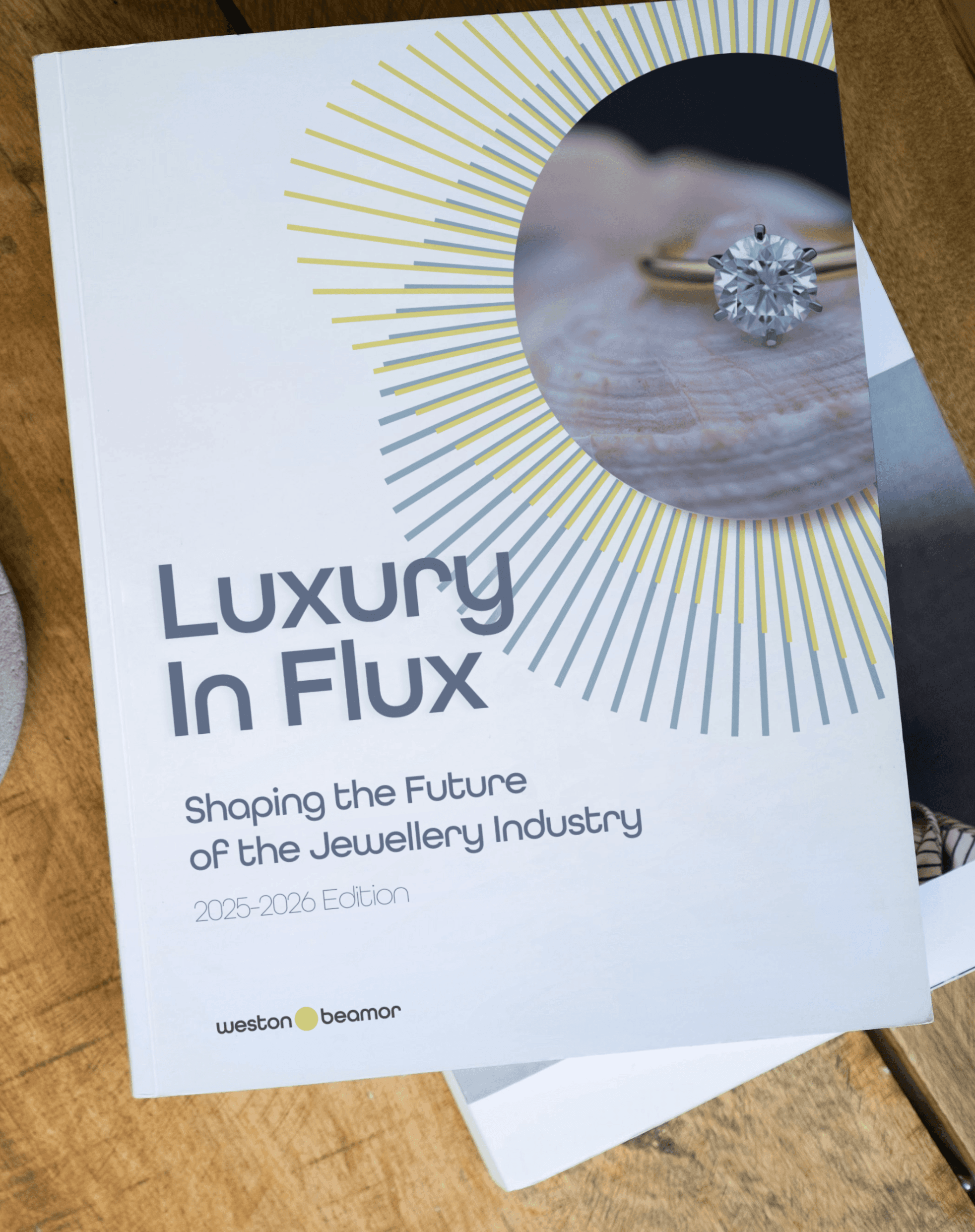
Sustainability is our standard, not an add-on. As an RJC-certified manufacturer, Weston Beamor operates under a strictly audited framework of ethics and environmental care.
We proudly work with Single Mine Origin (SMO) and, when possible, recycled metals to ensure that every gram of gold or silver in your collection supports a transparent, conflict-free supply chain.
Talk to our team to define your sourcing story and bring the transparency your customers are looking for.

Weston Beamor has been casting precious metals since 1947. Working with a broad spectrum of customers for nearly 80 years has made Weston Beamor one of the most respected and trusted names in the jewellery industry. Company Number 00465213